
Risk posture derived from truth.
Embed governance into the change lifecycle to automatically assess, guide, and produce audit evidence before changes occur. Compliance finally reflects real risk posture, not a checkbox.
Detect · See every change
Where do risks start?
From Changes
Gist automatically identifies and connects change signals across tickets, documents, code, and infrastructure. Intelligent agents then assess security, privacy, and compliance impact. From there, Gist proposes mitigations, routes decisions, and generates evidence.
Change identification & correlation
Atomic signals, correlated into one unit of change.
Gist correlates the scattered sources comprising a change initiative - across PRDs, tickets, docs, and AI coding sessions - into a single change. Maintaining a change as new signals happen is critical; every new change signal is automatically correlated to the change initiative even as more PRs, docs, and tickets get created.
Assess · Agentic Risk Assessment
Automated assessments, grounded in your context
Context Graph
Changes mapped to your personalized context
Gist builds and maintains deep knowledge of a customer's environment to understand IT and organizational changes the way a senior security architect would. The Gist ‘context graph’ is informed by each company’s specific policies, controls, and environment.
The Context Graph comprises three layers: a governance library, organizational context and knowledge base.
Governance library
A management interface where security teams curate the organizational knowledge, policies, controls, and standards that Gist draws from. This becomes the intelligence layer, feeding context to produce accurate, organization-specific assessments and guidance.
Organizational context
Consists of services, config items, vendors, data classes, environments, owners, and teams. Links the organization's assets, people, vendors, and business processes. It comprises the vocabulary that Gist agents use to understand what a change affects and who should be involved.
Knowledge base
Built automatically through usage, the KB captures system and architecture mappings derived from assessed initiatives, recurring risk patterns, historical governance decisions (and their outcomes), and organizational context to make future assessments more accurate.
The artifacts
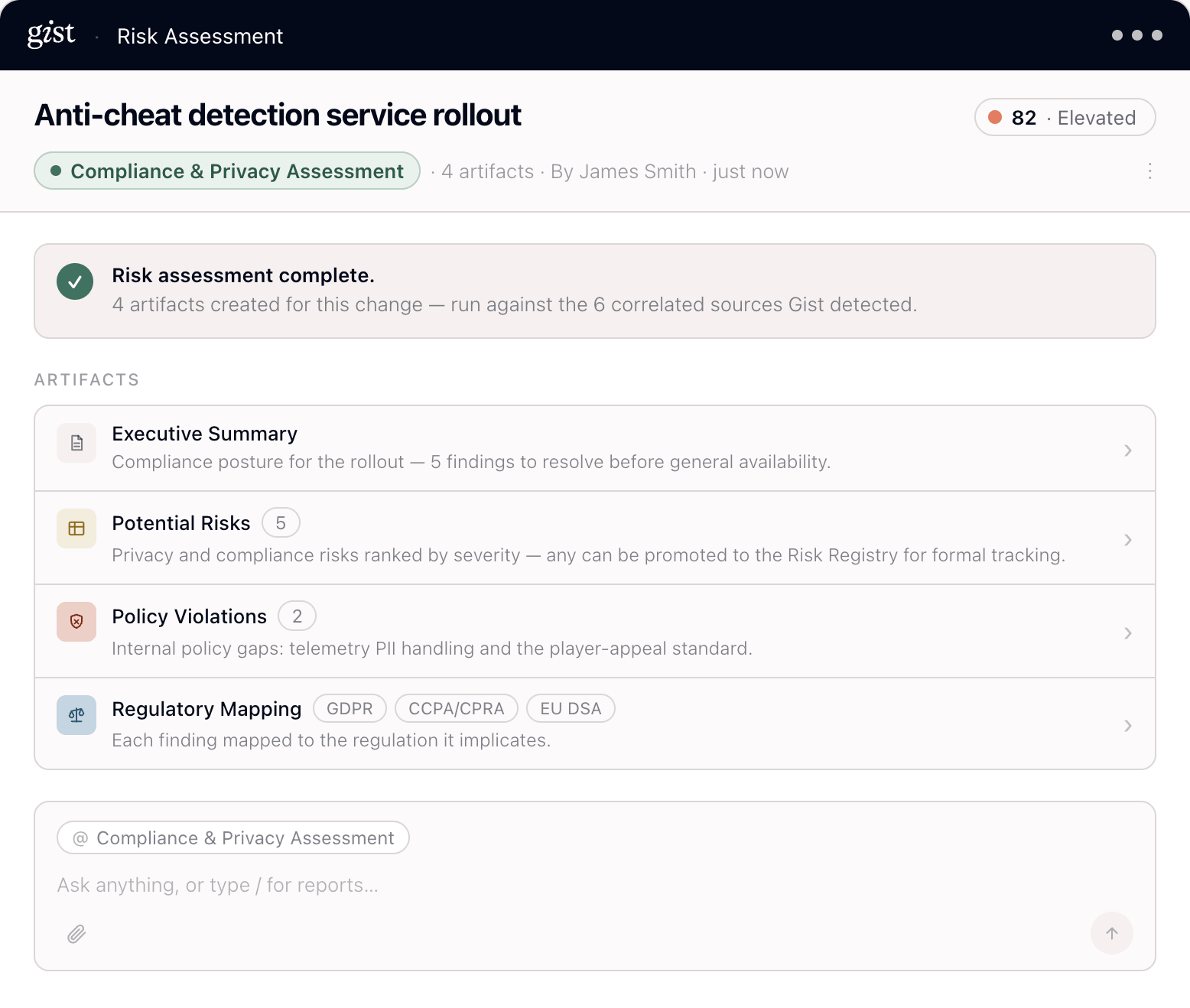
Consistent risk assessments, threat models and reviews
Gist's conversational, chat-based approach to risk assessment reads the sources, determines the right approach, and produces flexible artifacts.
Designed to support any approach - from fully structured to fully autonomous.
Consistent methodology (i.e. STRIDE/DREAD) is applied identically across every review, eliminating the variability that plagues manual reviews.
Guide · AI-assisted coding workflows
Guidance within developer, IT and agent workflows
In-workflow guidance
Governing agent-made change
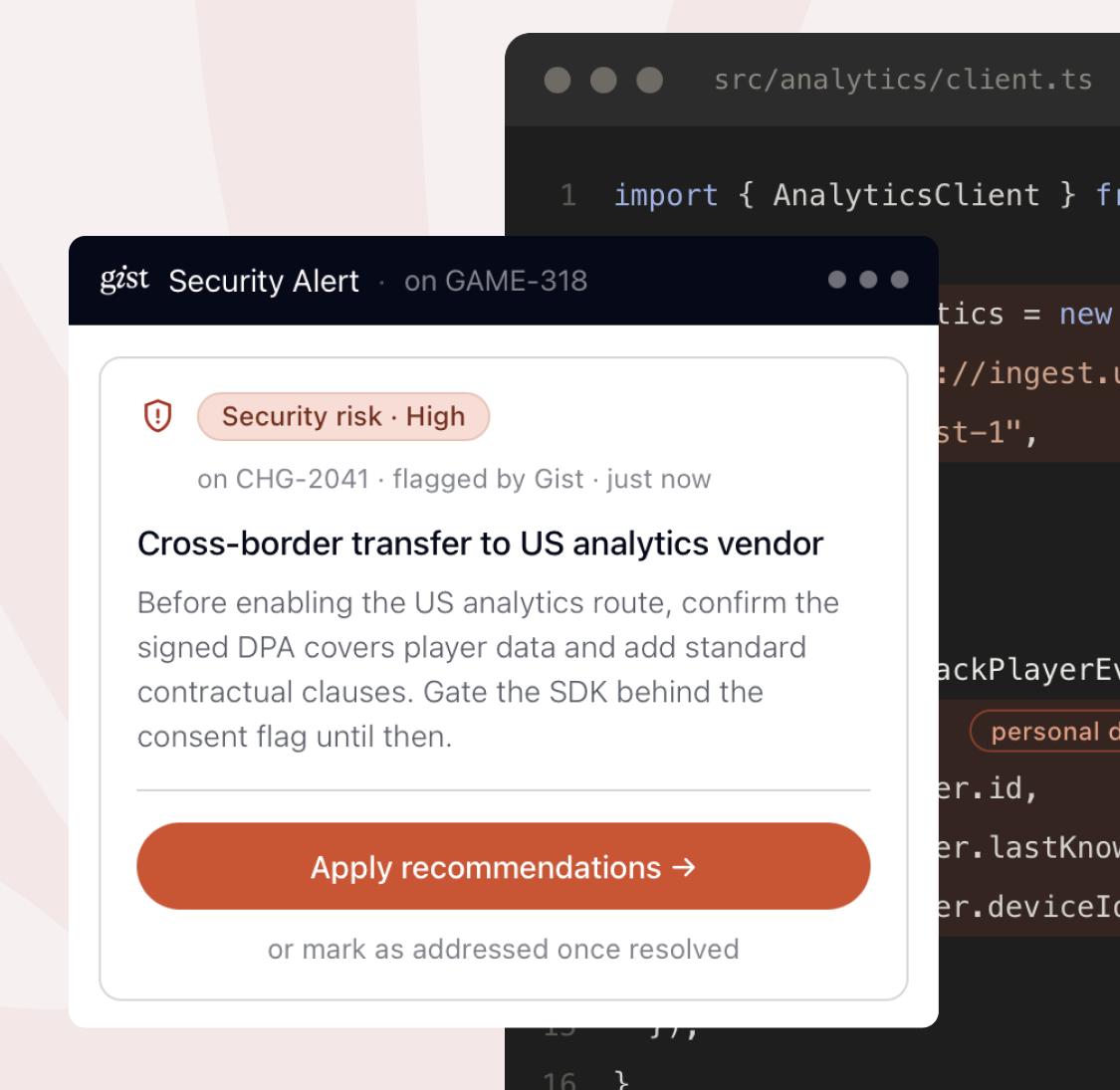
Agents now author change at a pace no review queue was sized for. Gist works inside tools like Cursor and Claude Code so that when a session touches something your policies govern, Gist flags it in place.
When code violates one of your policies or frameworks, Gist is invoked to fix the code. What it can't resolve in the session is scored as risk and routed to a human reviewer.
Findings
Escalate what matters
Human-Agentic balance: potential risks, vetted against your specific policies and controls, and escalated only when they matter. Gist minimizes noise.
Manage · Easy Audit Evidence
Evidence as a byproduct of work
Evidence & Audit
Audit-friendly by default
Every change carries the evidence behind each decision. Follow any risk back through the change proposed, assessment completed, decision taken, and artifact created. Nothing reconstructed after the fact.
Business-level risk escallated
Need updated image here and then we can write the text for it
Versioning and Evidence
Every change is versioned as it evolves and carries the evidence behind each decision. Easily reconstruct what was known, what was decided, and by whom, to trace any risk back to its source.
Risk register
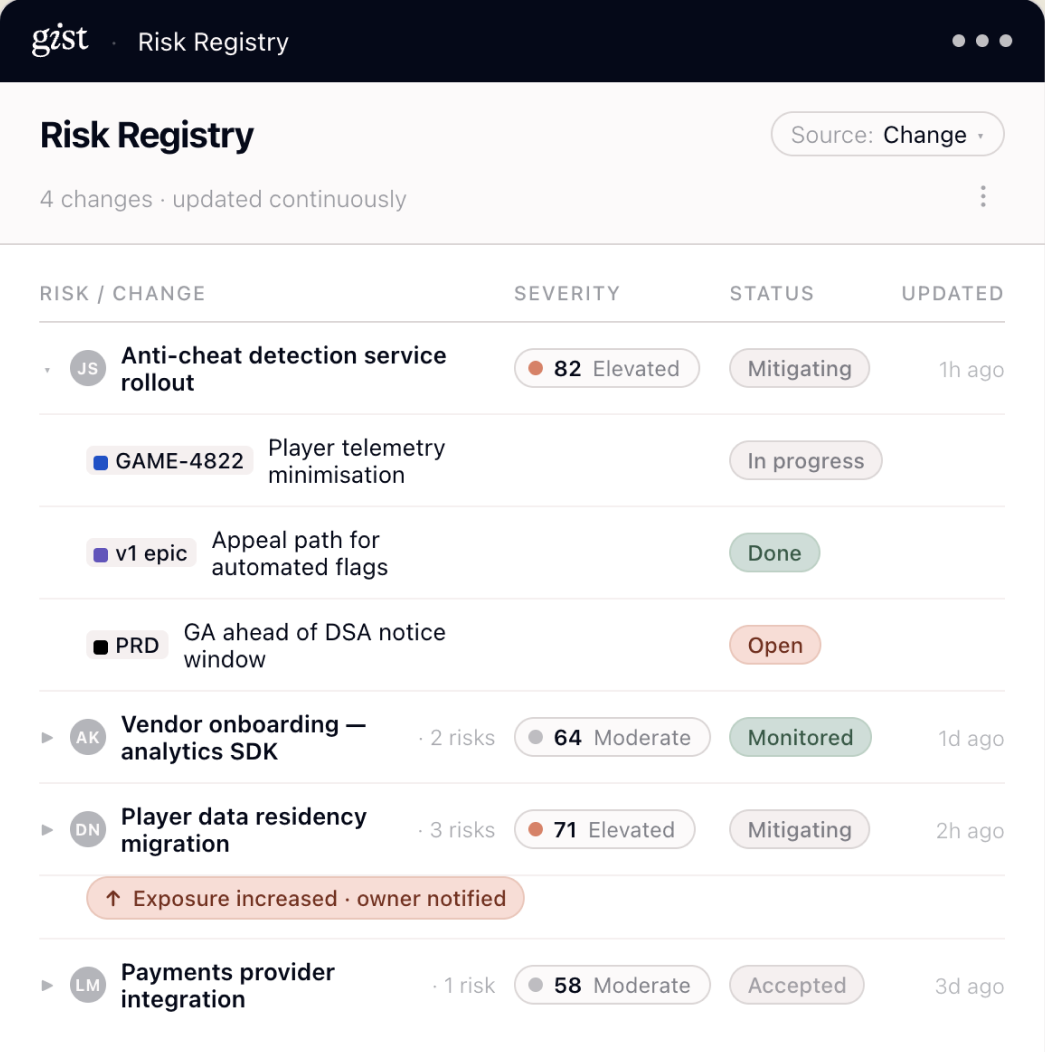
Truly dynamic risk register
The dynamic risk register is essentially an accountability layer for every consequential action a company or its agents take, covering each risk across its full lifespan. As changes happen, the registry automatically updates to update risk posture.
Make governance
change-native
"It is not the strongest of the species that survives... but the one most adaptable to change."